In the high-intensity world of college football, where performance is measured in tackles, speed, and game-changing plays, Harold Perkins Jr. has built a reputation as one of the most explosive defensive players in the nation. Representing the LSU Tigers, Perkins is known for his relentless energy, elite instincts, and the kind of physical dominance that defines SEC football.
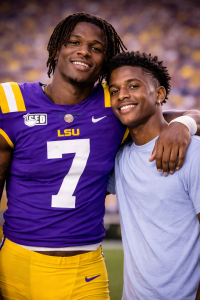
But beyond the roar of stadiums and the pressure of national expectations, there is another side to his story—one that has nothing to do with sacks or statistics, yet carries even greater weight.
A Season Interrupted, A Voice Emerges
In January 2026, reports confirmed that Perkins would miss the remainder of the season after suffering a serious ACL injury during a game against UCLA. For any athlete, especially one at the peak of his collegiate career, such an injury is devastating. It halts momentum, raises uncertainty, and forces a confrontation with vulnerability—something elite athletes rarely show publicly.
Yet, in the midst of this setback, Perkins’ name began circulating for a very different reason.
He chose to speak out.
Not about football. Not about his injury.
But about something deeply personal.
The Story Behind the Statement
According to those close to him, Perkins’ decision to publicly support the LGBTQ+ community did not originate from a desire for attention or a calculated media move. It came from a place far more intimate—his family.
At the center of this story is his younger brother.
Growing up, Perkins witnessed moments that left a lasting impression on him. His brother, like many young people who feel different, faced quiet judgment—subtle stares, whispered comments, and an environment that often lacked understanding. These experiences didn’t always manifest as overt hostility, but their impact was just as profound.
Over time, Perkins saw changes. A once vibrant personality became more reserved. Confidence gave way to hesitation. And the simple act of being oneself began to feel like a risk.
For Perkins, this wasn’t just observation—it was emotional reality.
“Football Taught Me Strength. Family Taught Me Humanity.”
As an athlete, Perkins had been trained to embrace toughness. Football, especially at the level he competes, demands discipline, resilience, and mental fortitude. Pain is something to push through. Pressure is something to thrive under.
But family taught him something different.
It taught him empathy.
It taught him that strength is not only about physical dominance, but also about standing up for those who cannot always stand up for themselves.
When Perkins finally spoke, his words carried that dual identity—an elite competitor shaped by the game, and a brother shaped by love and responsibility.
“If my brother needs to know that he’s not alone, then I’m willing to take any pressure.”
The Risk of Speaking Out
In the culture of college football, discussions around social issues can be polarizing. Many believe athletes should focus solely on their sport, avoiding topics that might divide fans or attract controversy.
Perkins understood that reality.
He knew that by speaking publicly, he would invite criticism. Some would question his priorities. Others might disagree with his stance entirely.
But for him, the decision was never about winning approval.
It was about necessity.
There comes a point, he realized, where silence is no longer neutral—it becomes complicity. And for Perkins, staying silent would have meant ignoring the struggles of someone he loved.
Redefining Leadership in Modern Sports
At LSU Tigers, Perkins has long been seen as a defensive leader—a player whose presence elevates the entire unit. But leadership today is evolving.
It’s no longer defined solely by performance on the field.
Modern athletes operate in a space where their voices carry influence far beyond the game. Social media, public platforms, and cultural visibility have transformed them into figures who can shape conversations, challenge norms, and inspire change.
Perkins represents this new generation.
He didn’t abandon his role as an athlete—he expanded it.
By speaking out, he demonstrated that leadership includes accountability, compassion, and the courage to address uncomfortable truths.
The Human Side of the Game
Sports often celebrate physical excellence, but stories like Perkins’ remind us of something deeper: athletes are human beings first.
They carry personal histories, relationships, and emotional experiences that shape who they are. Behind every highlight reel is a life filled with moments unseen by the public.
For Perkins, football may have given him a platform, but his family gave him a purpose.
And when those two worlds intersected, he made a choice that transcended the boundaries of sport.
A Message That Resonates
The impact of Perkins’ decision extends beyond his immediate circle. For young fans, especially those who feel marginalized or misunderstood, his words carry significant meaning.
Representation matters.
Support matters.
Knowing that someone in a position of visibility is willing to stand up—even at personal cost—can change how individuals see themselves and their place in the world.
Perkins didn’t present himself as a hero.
He simply acted as a brother.
Yet, in doing so, he became something more to many others.
Courage Beyond the Field
In football, courage is often associated with physical acts—charging into contact, playing through injury, making split-second decisions under pressure.
But there is another kind of courage.
The courage to speak when it would be easier to stay silent.
The courage to risk criticism for the sake of truth.
The courage to prioritize people over perception.
Harold Perkins Jr. showed that this form of courage may be the most powerful of all.
Conclusion: When Silence Is No Longer an Option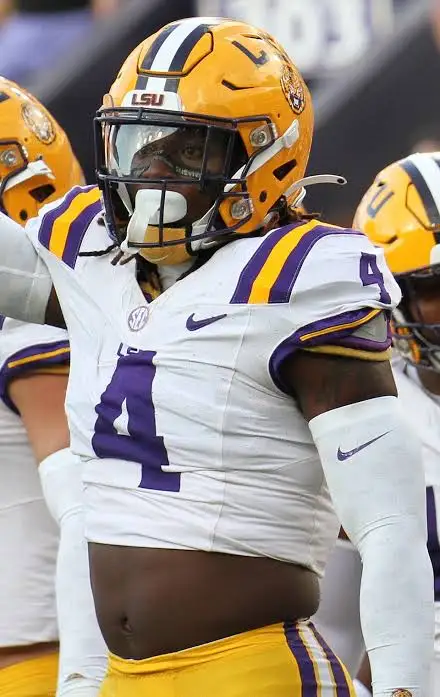
The story of Harold Perkins Jr. is not just about a talented linebacker facing a difficult season-ending injury. It is about a defining moment—one where personal values outweighed public expectations.
In a world where athletes are often told to “stick to sports,” Perkins chose a different path.
He chose family.
He chose empathy.
He chose to speak.
And in doing so, he reminded everyone watching that sometimes, the greatest strength is not found in physical dominance, but in the willingness to stand up for what truly matters.
Because in the end, the most important victories are not always recorded on the scoreboard—they are felt in the lives we choose to protect.