In an era where headlines are dominated by contracts, endorsements, and highlight reels, Harold Perkins Jr. has chosen a radically different narrative—one defined not by fame, but by purpose.
There were no flashing cameras. No celebrity guests. No ceremonial ribbon stretched across polished glass doors. At exactly 6 a.m., as the first light of dawn broke across the horizon, two doors opened quietly. And with that, a $122 million vision became reality.
A Hospital Built in Silence
The Harold Perkins Medical Center didn’t arrive with hype—it arrived with intention.
Funded entirely through private means and developed far from public scrutiny, the 250-bed facility was designed with one mission: to provide completely free, lifelong healthcare for the homeless. No insurance. No paperwork barriers. No conditions.
For Perkins, this wasn’t a publicity move. It was a statement.
“This is the legacy we choose to leave behind.”
That philosophy is embedded into every inch of the facility. From emergency surgical units to long-term rehabilitation programs, the center functions more like a full-scale ecosystem of care than a traditional hospital.
More Than Medicine — A Path to Rebuilding Lives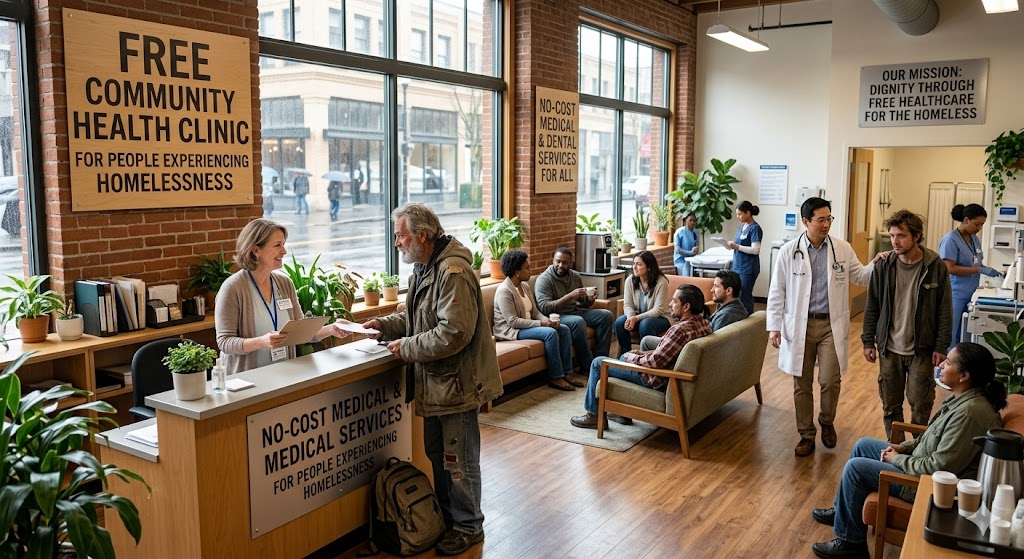
What makes this initiative extraordinary isn’t just its scale—it’s its scope.
The center offers:
- Advanced cancer treatment
- Emergency and trauma surgery
- Mental health services
- Addiction recovery programs
- Dental care
- Permanent housing solutions
This is not simply about treating illness. It’s about addressing the entire cycle of vulnerability.
Homelessness and healthcare are deeply interconnected. Without stable housing, recovery becomes nearly impossible. Without treatment, reintegration into society becomes a distant hope. Perkins’ model tackles both simultaneously—something few institutions have successfully achieved.
Each patient is not just treated, but supported through a long-term recovery plan that includes housing, counseling, and reintegration assistance. It’s a structural solution, not a temporary fix.
The First Patient: A Moment That Defined Everything
As the doors opened that morning, the first person to walk in was James—a retired Navy veteran who had spent years battling both physical illness and homelessness.
There were no administrators greeting him. No media documenting the moment.
Instead, standing at the entrance was Perkins himself.
He didn’t deliver a speech. He didn’t pose for a photo.
He simply welcomed him.
“This place exists so no one is forgotten anymore.”
That moment captured the essence of the entire project. Not charity. Not obligation. But dignity.
Why Perkins Chose This Path
For many athletes, legacy is measured in championships, records, and Hall of Fame inductions. But Perkins appears to be redefining that metric entirely.
Those close to him suggest this vision was years in the making. Influenced by personal experiences, community exposure, and a deep awareness of systemic inequality, Perkins reportedly became increasingly focused on impact beyond football.
While still early in his career, he’s already thinking in terms most athletes reserve for retirement.
And that’s what makes this story so compelling.
He didn’t wait.
A New Blueprint for Athlete Philanthropy
Athletes have long been involved in charitable work—donations, foundations, community programs. But what Perkins has created is fundamentally different in both scale and structure.
This is not:
- A short-term initiative
- A brand partnership
- A seasonal campaign
This is infrastructure.
A fully operational institution capable of serving thousands of individuals every year, indefinitely.
In many ways, it sets a new benchmark. It challenges other high-profile figures—not just athletes—to reconsider what meaningful impact actually looks like.
The $122 Million Question
One of the most intriguing aspects of this story is how it remained completely under the radar.
A project of this magnitude typically involves public filings, media leaks, or corporate sponsorships. Yet this one moved in silence until the moment it was ready to serve.
That secrecy wasn’t accidental.
According to those familiar with the project, Perkins insisted that the focus remain entirely on execution—not attention. The doors would only open when the system was fully capable of delivering on its promise.
No half-measures. No symbolic gestures.
Only results.
Healthcare as a Human Right
At its core, this hospital represents something much larger than one individual’s generosity.
It raises a fundamental question:
What if access to healthcare wasn’t tied to income, status, or stability?
For the homeless population, healthcare is often reactive—emergency rooms, temporary fixes, and inconsistent follow-ups. Preventative care, long-term treatment, and mental health support are luxuries they rarely receive.
Perkins’ model flips that entirely.
By offering comprehensive, continuous care, the center has the potential to drastically reduce:
- Emergency room overload
- Chronic untreated conditions
- Relapse rates in addiction recovery
- Long-term homelessness cycles
It’s not just compassionate—it’s strategically transformative.
The Human Impact
Beyond the numbers and services, the real impact will be measured in stories.
- The cancer patient who finally receives consistent treatment
- The recovering addict who finds stability and purpose
- The veteran who regains both health and housing
- The individual who, for the first time in years, feels seen
These are the outcomes that don’t make headlines—but define legacies.
A Legacy Already Taking Shape
It’s rare to see someone so early in their public career make a decision that so clearly defines how they will be remembered.
For Harold Perkins Jr., this hospital may ultimately become more significant than anything he achieves on the field.
Because championships fade. Records are broken.
But institutions like this?
They endure.
Final Thoughts
In a world increasingly driven by visibility, Perkins chose invisibility—until the moment impact was unavoidable.
No announcement. No countdown. No spectacle.
Just open doors.
And people walking through them, finally receiving the care they’ve been denied for far too long.
If legacy is truly about what we leave behind, then Perkins has already started building something that extends far beyond football.
Not a highlight.
Not a headline.
But a lifeline.